


Digital marketing is evolving at a breakneck pace, with global trends revealing surprising shifts in strategy and performance. To stand out and attract savvy clients; it's crucial to leverage original research and hard data rather than generic advice. Below, we explore several compelling data-backed insights that can position your brand as a leader in your field. The focus is global and spans key areas from ROI and customer acquisition to AI and channel strategy, displaying data in an easy-to-grasp format.
Launch Your Website in Minutes - Start For Free.
Key Insights at a Glance
Digital dominates advertising
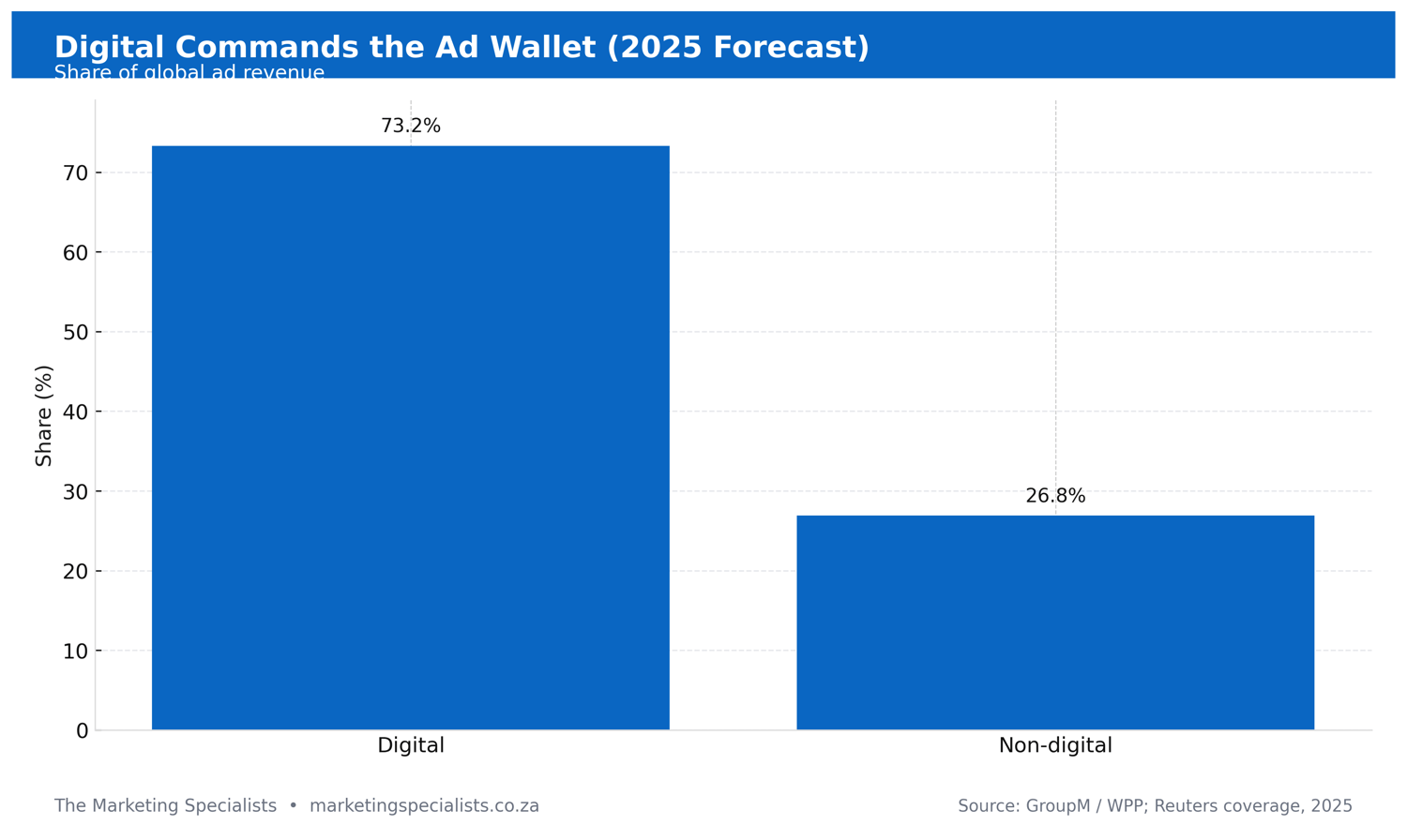
~70% of worldwide ad spending now goes to digital channels, and marketers see about a 5:1 return on average for their digital marketing investments. Global digital ad spend hit $790 billion in 2024 (10% higher than 2023).
ROI varies by channel
Email marketing delivers the highest ROI - up to $36 for every $1 spent, whereas SEO returns ~$22 and PPC about $2. Nearly 49% of marketers say organic search (SEO) yields the best ROI of any channel, yet new challenges like "zero-click” searches (nearly 60% of Google searches now end without a click) are changing how we capture that value.
Retention over acquisition
Facing rising costs, 64% of brands are investing more in customer loyalty programs and 62% in personalized email campaigns, while dialing back purely acquisitive marketing. Keeping existing customers happy is often more cost-effective than pricey new customer ads, especially as ad costs (CPC, CPA) climb.
AI in marketing is hot - but cautious
78% of marketing teams plan to boost AI capabilities in 2026, with 76% specifically investing in generative AI for content creation. However, many are still in exploratory stages due to concerns about cost, integration and skills. The enthusiasm is high, but full adoption is gradual and strategic.
Content is king again (thanks to privacy shifts)
Brands are pouring budget into content marketing, influencer partnerships, and AI-driven creative, while cutting back on programmatic ads, retargeting, and other cookie-dependent tactics. With third-party cookies fading and data privacy rising, compelling content and first-party engagement are now critical to reach audiences directly.
Tried-and-true channels vs. emerging platforms
In an uncertain economy, marketers stick to what works; Google Ads, Facebook, YouTube, Instagram, and LinkedIn were rated the most effective digital channels in the previous year. Newer platforms (e.g. TikTok, podcast ads, connected TV) were deemed less effective by many pros, reflecting caution. Yet ignoring emerging platforms is risky: TikTok's ad reach has exploded to 1.56 billion monthly users (nearly on par with Instagram), and the average TikTok user now spends over an hour per day on the app, more than any other social network.
Each insight is explored in detail below with data visuals and analysis to inform your strategy for 2026.
Global Growth and ROI: Digital Marketing's Big Picture
Digital marketing has become the dominant force in advertising worldwide. In 2023, marketers spent roughly $720 billion on digital ads, over 10% more than the previous year[4]. This surge means digital channels captured about 70% of all ad spending globally in the previous year. In fact, 58% of small business's now rely on digital marketing as their primary way to reach customers, indicating that online channels are no longer optional, but essential, for business's of all sizes.
Not only is spending up, but returns are impressive: on average, business's earn about $5 for every $1 spent on digital marketing. However, this ROI is not evenly distributed across all digital channels. Some channels yield much higher returns than others, a critical consideration for budget allocation.
Average ROI per $1 spent by channel: Email marketing vastly outperforms other digital channels, delivering about $36 in revenue per $1 (3600% ROI). SEO (organic search optimization) returns roughly $22 per $1, while PPC advertising (paid search ads) returns about $2. This data underscores how prioritizing the right channels can dramatically improve marketing efficiency.
Why do these differences matter? In practice, it'suggests mature, established tactics like email and SEO often provide the biggest bang for the buck. Email's incredible ROI (driven by its low cost and direct reach) and organic search's strong performance show the value of nurturing owned audiences and search visibility. By contrast, PPC's relatively low average return reminds us that paid ads can quickly eat budget and must be optimized carefully to be profitable.
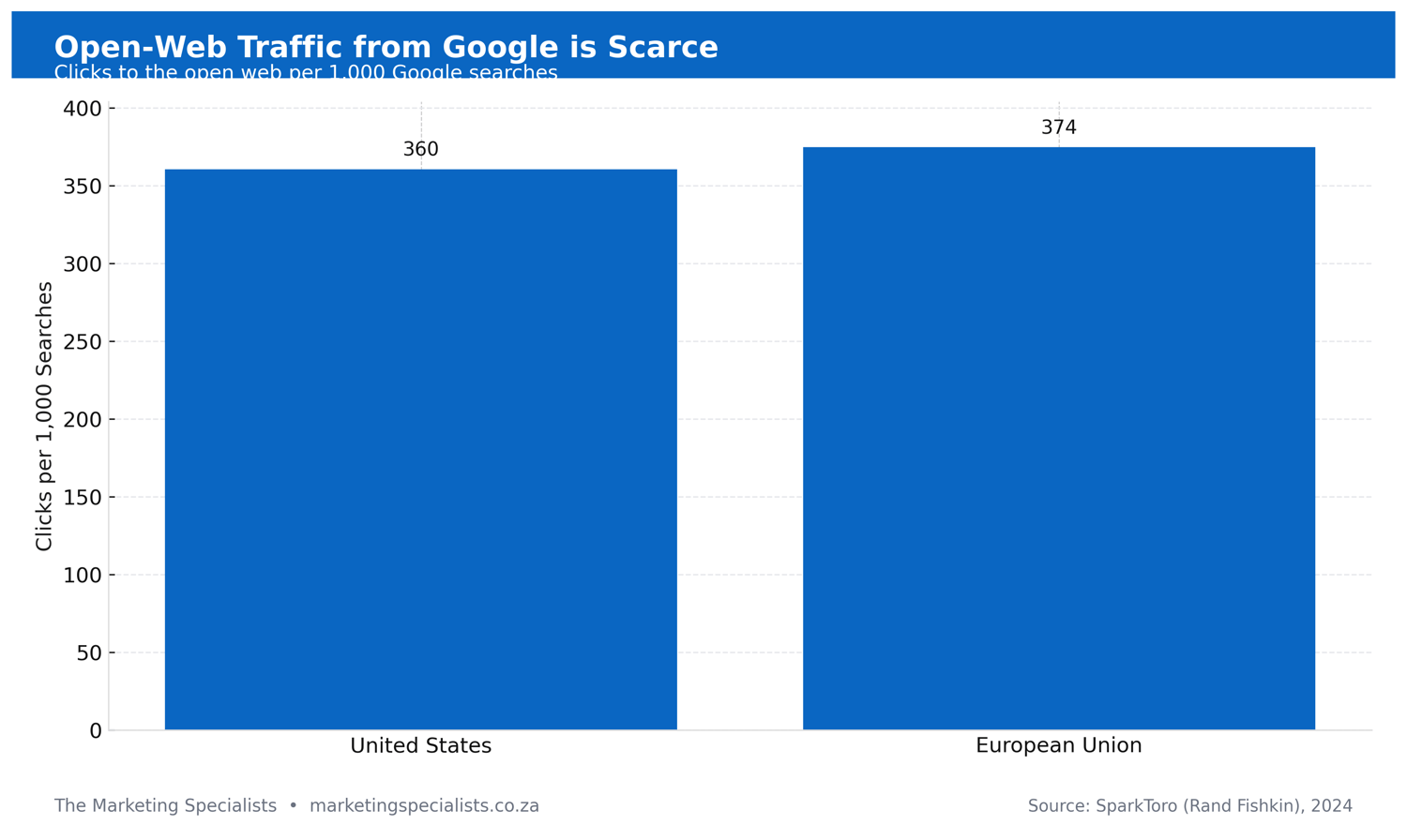
It's no wonder that in a recent survey, 49% of marketers ranked organic search (SEO) as the digital channel with the best ROI. But capturing that value from search is getting tricky, a recent study by Rand Fishkin found that nearly 60% of Google searches now end without any click (users get their answer on Google's page itself). Additionally, almost 30% of clicks go to Google's own properties (YouTube, Maps, etc.), leaving only about 36% of clicks for external sit's.
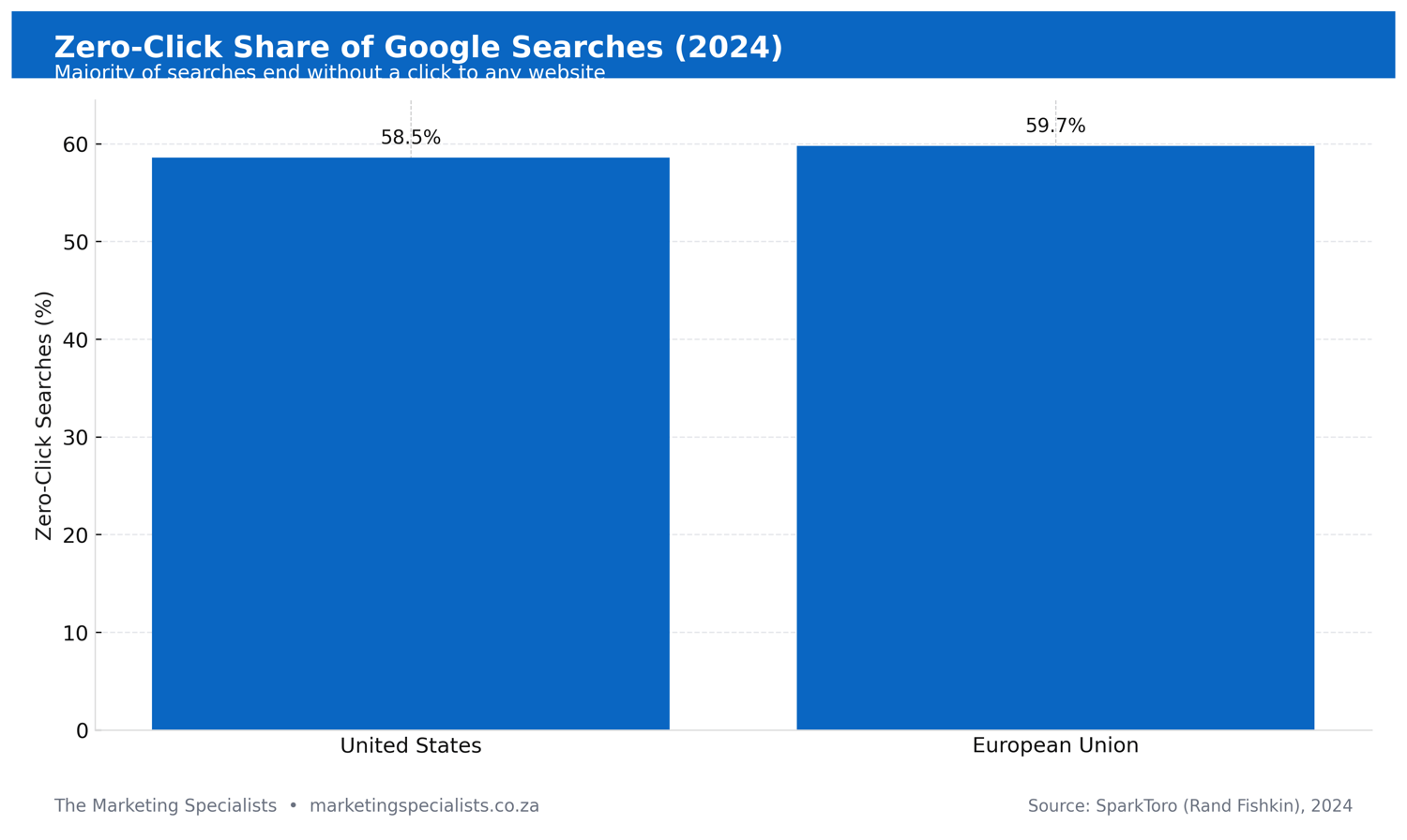
Implication: Even as SEO remains vital, marketers need to adapt content strategies for a zero-click world (e.g. optimizing for featured snippets, integrating FAQ schemas, and focusing on on-site engagement) to ensure their organic efforts translate into traffic and leads.
Another macro trend is programmatic advertising's takeover: over 80% of digital ad buying is now automated/programmatic. This has streamlined media buying but also leveled the playing field, simply pouring money into programmatic display ads is less of a competitive advantage when everyone is doing it. Success lies in the creative and targeting strategy behind those programmatic buys.
Key takeaway: The global data urges marketers to focus on high-ROI channels and tactics. Double down on owned media like email lists and content that drives organic search traffic. Use paid ads strategically where they can augment these efforts (for instance, retargeting engaged prospects), but be mindful of diminishing returns. In a climate where digital spend is ever-growing, smart allocation of that'spend; guided by ROI data, is what'sets apart the leaders from the laggards.
Launch Your Website in Minutes - Start For Free.
From Acquisition to Retention: The Shift to Loyalty
In 2025, there's been a notable strategic pivot among savvy brands: a shift from aggressive customer acquisition to nurturing loyalty and retention. The data behind this shift is compelling. In one survey of 500 marketing leaders, 64% of brands said they are investing heavily in loyalty or rewards programs, and 62% are focusing on personalized email campaigns to engage existing customers. Additionally, 54% are enhancing customer'service and support efforts to strengthen relationships.
This represents a significant re-balancing of marketing priorities toward keeping customers rather than only chasing new ones.
Why the change? Several factors are driving it:
Rising acquisition costs
The cost to acquire new customers online has been climbing. Pay-per-click ad rates and cost-per-acquisition (CPA) metrics have increased, meaning those Facebook or Google ads that once delivered cheap leads are now more expensive. When CPCs and CPAs rise, the math for acquisition campaigns becomes tougher to justify, pushing marketers to seek better ROI elsewhere.
Retention is cost-effective
It's long been known in marketing that retaining a customer is cheaper than acquiring a new one. The current data reinforces this; brands see that investing in loyalty (e.g., rewards, VIP programs) and personalized engagement can yield more stable revenue without the constant heavy ad spend. An existing satisfied customer is more likely to buy again (and at a higher lifetime value) than a cold prospect.
Privacy changes & less third-party data
As privacy regulations tighten and third-party cookies are phased out, targeting new prospects has become more challenging. Marketers can't rely as heavily on ultra-targeted ads to strangers based on third-party data. In response, many are prioritizing known customer data (first-party data) and building on existing relationships where they have consent to communicate. Loyalty programs and email newsletters shine here because they leverage data customers have willingly shared.
Need for predictable ROI
In uncertain economic times, business's crave predictability. Existing customers often provide more predictable sales streams (subscriptions, repeat purchases) than the volatile returns from big acquisition pushes. By focusing on retention, brands aim for steadier revenue and ROI that they can count on even if ad budgets get cut.
This doesn't mean acquisition is dead, far from it. But it'signals a more balanced approach: smart brands allocate more effort to delighting and upselling their current customers, turning them into advocates, repeat buyers, and sources of word-of-mouth. Tactics like exclusive loyalty rewards, personalized follow-up offers, re-engagement emails, and superior customer'support can significantly lift retention rates.
For instance, the survey showed a majority leaning into personalized email. This is no surprise; email marketing is not only high-ROI as noted earlier, but also a versatile retention tool. Companies are using segmented email campaigns to re-engage lapsed users, recommend relevant products based on purchase history, and generally make customers feel valued post-sale. Similarly, enhancing customer'service (investing in better support channels, responsive social media care, etc.) helps reduce churn by resolving issues before customers leave.
In summary, customer loyalty is the new battleground. Marketers who can increase the lifetime value of their customer base will reap more profits and need to spend less on constant reacquisition. As a thought leader, you might emphasize how your strategies or services help clients maximize retention; whether through CRM programs, content that adds post-purchase value, or community-building around the brand. The data backs this up: retention efforts are where a large chunk of the industry is heading, for good reason.
The AI Revolution in Marketing: High Interest, Measured Adoption
Few topics have generated as much buzz in marketing circles recently as Artificial Intelligence (AI). From machine learning algorithms optimizing ad spend to generative AI tools creating content, AI promises to transform how marketing is done. The reality on the ground in 2025 is one of eager interest tempered by practical caution.
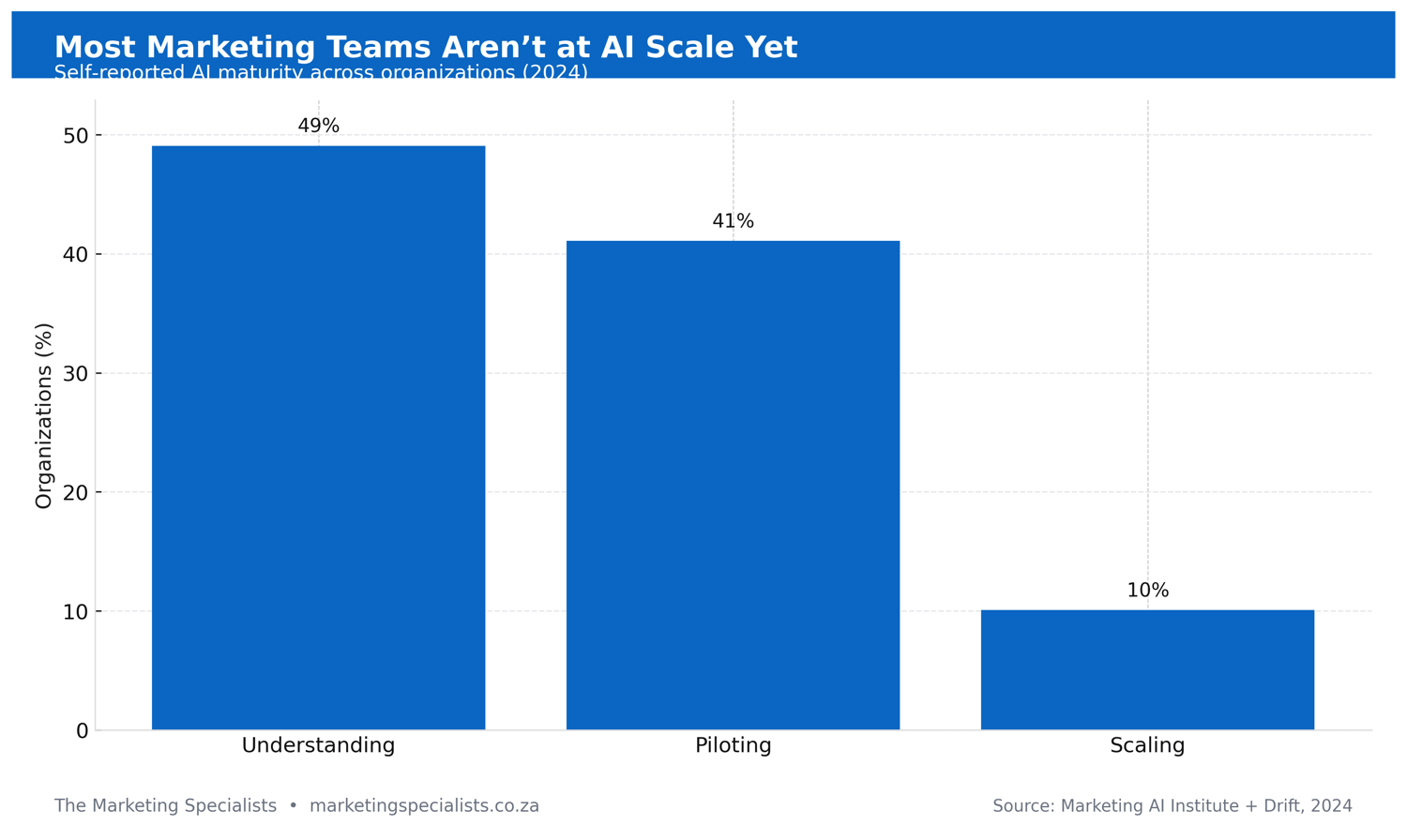
According to a global survey, 78% of marketing teams plan to upgrade or enhance their AI capabilities in the coming year. The majority are especially interested in Generative AI (GenAI) for content and creative tasks; among those investing in AI, 76% are targeting GenAI solutions (like AI copywriting, image generation, chatbots, etc.). Other popular areas of AI investment include using AI in creative production workflows (51%) and in data science/analytics (46%). This shows that marketers see AI as a multi-faceted tool: automating content creation, scaling creative asset production, and extracting insights from big data are all on their agenda.
However, while interest is high, many brands remain cautious in implementation. Adopting AI is not a simple flip of a switch, and survey respondents acknowledged several challenges:
Skill and knowledge gaps
Marketing teams may lack in-house AI expertise. Understanding how to properly deploy AI tools (and interpret their outputs) requires new skills that teams are still building. There's a learning curve, and not every company has a dedicated data science team on standby.
Integration and cost concerns
Implementing AI often means investing in new software, integrating it with existing systems, and possibly hiring new talent or training staff. Budget constraints and uncertainty about ROI can slow down AI projects. Marketers are under pressure to justify any expensive tech initiative with clear results, and AI, being relatively new, sometimes feels experimental.
Quality and trust issues
While GenAI can produce content drafts or ad variations in seconds, marketers worry about quality control; AI can make factual errors or produce on-brand content that'still needs human polishing. There's also the matter of trusting AI-driven decisions (for example, letting an algorithm auto-optimize campaigns) when the "why” behind those decisions isn't always transparent.
Ethical and brand'safety considerations
Using AI in customer interactions (like chatbots or personalized content) raises questions. Marketers must ensure AI outputs align with brand voice and values. Additionally, concerns about data privacy and AI (using customer data responsibly for AI models) mean companies are treading carefully.
That'said, the momentum is unmistakable. AI is no longer a futuristic concept; it's a present reality reshaping marketing operations. From automating routine tasks to enhancing personalization, AI offers efficiency and scale that traditional methods can't match. For example, AI can analyze customer behavior data to segment audiences far more granularly, or it can rapidly A/B test creative variations to find what resonates best. These capabilities can free up human marketers to focus on strategy and creative thinking.
What we're seeing is a pragmatic adoption pattern: many firms are starting with small AI pilot projects or leveraging AI features built into existing platforms, rather than betting everything at once. A smart approach (as experts advise) is to integrate AI in a gradual, targeted way, e.g., use AI to automate a repetitive reporting task, or to generate initial draft copy for blog posts that a human then edits. This lets teams get comfortable with the technology and measure results on a small scale. As confidence grows, they can scale up AI's role.
From a thought leadership perspective, showcasing knowledge in AI, and realistic ways to implement it; can set you apart. The data shows companies want AI, but need guidance on how to do it right. You might discuss how your agency is using AI tools (like for data analysis or content optimization) and how that directly benefits clients. Emphasize a balanced approach: AI should augment human creativity and decision-making, not replace it. The winners in 2026 will be those who leverage AI efficiently to gain insights and scale, without losing the human touch in marketing that ensures content and campaigns truly connect with people.
Launch Your Website in Minutes - Start For Free.
Content is King (Again): Navigating Privacy Changes with Creativity
Amid the rise of AI and automation, an interesting counter-trend has emerged: a renewed emphasis on creative, human content and brand experiences. With digital marketing's technical side becoming highly automated, what'sets brands apart now is often the quality of their content and the strength of their customer relationships. This shift is being accelerated by significant privacy changes that are reshaping the advertising landscape.
According to industry research, the previous 2 years saw a noticeable increase in investments in content marketing, influencer marketing, digital experience platforms (DXPs), and AI-driven creative production. In contrast, more traditional data-driven tactics like programmatic advertising, conversion rate optimization (CRO), retargeting, and even organic social media posting are seeing reduced investment. Why? Their effectiveness is declining in the face of new privacy rules and the phase-out of third-party cookies[26]. In simpler terms, it's become harder to target individuals with ads or track them across sit's, which diminishes the returns on hyper-targeted programmatic ad buys and retargeting campaigns.
What fills the gap? Brands are refocusing on what they can control: creating compelling content and experiences that attract and engage users directly. As one report put it, companies are putting more resources into "unique and personalized content and creative” as key differentiators in a world where algorithms alone can't guarantee reach. If you can't rely on micro-targeting an ad to the perfect user at the perfect time (because of data limitations), the alternative is to make your content so valuable and resonant that people'seek it out and share it, even with less targeting.
Consider a few implications of this shift:
Quality over quantity in content
Marketers are realizing that pumping out dozens of ads or posts with mediocre content won't work as well in an era of content saturation and higher user privacy. Instead, the focus is on high-quality, "distinctly human” content that forges an emotional connection. Storytelling, authenticity, and creativity are paramount. For example, a genuinely helpful blog post or an entertaining video can still cut through the noise and organically earn traffic or shares, even as paid reach becomes harder.
First-party data and owned audiences
With third-party cookies on the way out, collecting and utilizing first-party data (information you get directly from your audience) is gold. Content helps facilitate this, think of interactive content or gated premium content that users willingly engage with or sign up for. Brands are building their own databases of leads (through newsletter signups, loyalty program memberships, etc.) so they don't have to rely on external ad targeting as much. Email newsletters, communities, and podcasts have all seen renewed interest as channels that aren't at the mercy of, say, Facebook's algorithm changes.
Diversified content formats and channels
We also see marketers experimenting with formats beyond the standard blog or banner ad. Video, infographics, podcasts, webinars, interactive tools, these can create richer experiences that users actively enjoy. For instance, interactive infographics or data visualizations (perhaps summarizing original research) can earn backlinks and engagement that no simple text ad could. The strategy is to engage users on your own terms, on platforms or media where you have more control.
Influencer and user-generated content
Influencer marketing remains a strong tactic, but it's evolving. Rather than just sponsored posts for reach, brands are collaborating with influencers to create more authentic content and tap into niche communities. User-generated content (UGC) is another piece, encouraging your customers to share their experiences (reviews, unboxing videos, etc.) provides social proof and fresh content without privacy issues, since it's voluntarily shared by users. These approaches align with a world where trust and authenticity carry weight.
All these efforts underscore a core point: as targeted advertising signals diminish, content becomes the way to target. Great content is naturally magnetic to the right audience. Moreover, it complements SEO (which remains vital, recall that SEO drives over half of website traffic on average). High-quality content improves your search rankings and draws organic visitors, mitigating some loss from paid targeting.
From a thought leadership angle, you can capitalize on this trend by highlighting your expertise in content strategy. Perhaps share insights on how to create content that resonates in your specific industry, or how to leverage new formats like interactive tools.
Emphasize that you understand the balance between data-driven marketing and creative brand-building. The data backs you up here: brands investing in content and creative are doing so because it's one of the last best ways to reach customers in a privacy-first digital world. By championing authentic content and customer experience, you not only align with this trend but also appeal to clients who see their old ad tactics yield less and are looking for guidance on what to do next.
Balancing Proven Channels with New Opportunities
One of the trickiest challenges for marketers is deciding where to invest their time and budget, especially when new platforms emerge constantly, but not all of them deliver results. Recent data shows a clear pattern: in uncertain economic times, most brands are doubling down on the channels with a proven track record and being more cautious about experimental platforms. However, there's also a risk in playing it too safe, as emerging platforms can present huge opportunities if approached smartly. Let's unpack this balancing act.
According to the latest marketing leaders survey, the top-performing digital channels (in terms of effectiveness) were the usual suspects: Google Ads (paid search), Facebook, YouTube, Instagram, and LinkedIn. These platforms have been around for years (or decades) and have large, well-established user bases. Marketers feel confident investing here because they've historically seen solid ROI from them and know how to navigate their ad tools. During economic instability, it's understandable to stick with what you know works. Why pour money into an unproven channel when you can put it into a Google search campaign that reliably drives sales?
On the flip side, channels like TikTok, programmatic display networks, podcast advertising, and connected TV streaming ads were rated as less effective by many respondents. This indicates a hesitancy to allocate big budgets to newer or niche channels. TikTok, for instance, despite its rapid growth, is still perceived by some traditional marketers as a bit of a wildcard; its ad platform is newer, and measuring its direct ROI can be challenging. Podcasts and CTV are similarly in nascent stages for a lot of brands, lacking widespread case studies. Essentially, marketers are in a "wait and see” mode on these: interested but not ready to bet big.
However, here's the paradox: those emerging channels are where audience attention is rising fastest. Take TikTok as the prime example. Users' time spent per month on top social platforms (global averages, Q3 2023, Android devices). TikTok users now spend about 34 hours per month on the app on average, which is roughly an hour every day. This engagement is ~6 hours more per month than on second-place YouTube (~28 hours), and more than double the time spent on Instagram (~16 hours per month). The chart highlights TikTok's unprecedented level of user attention.
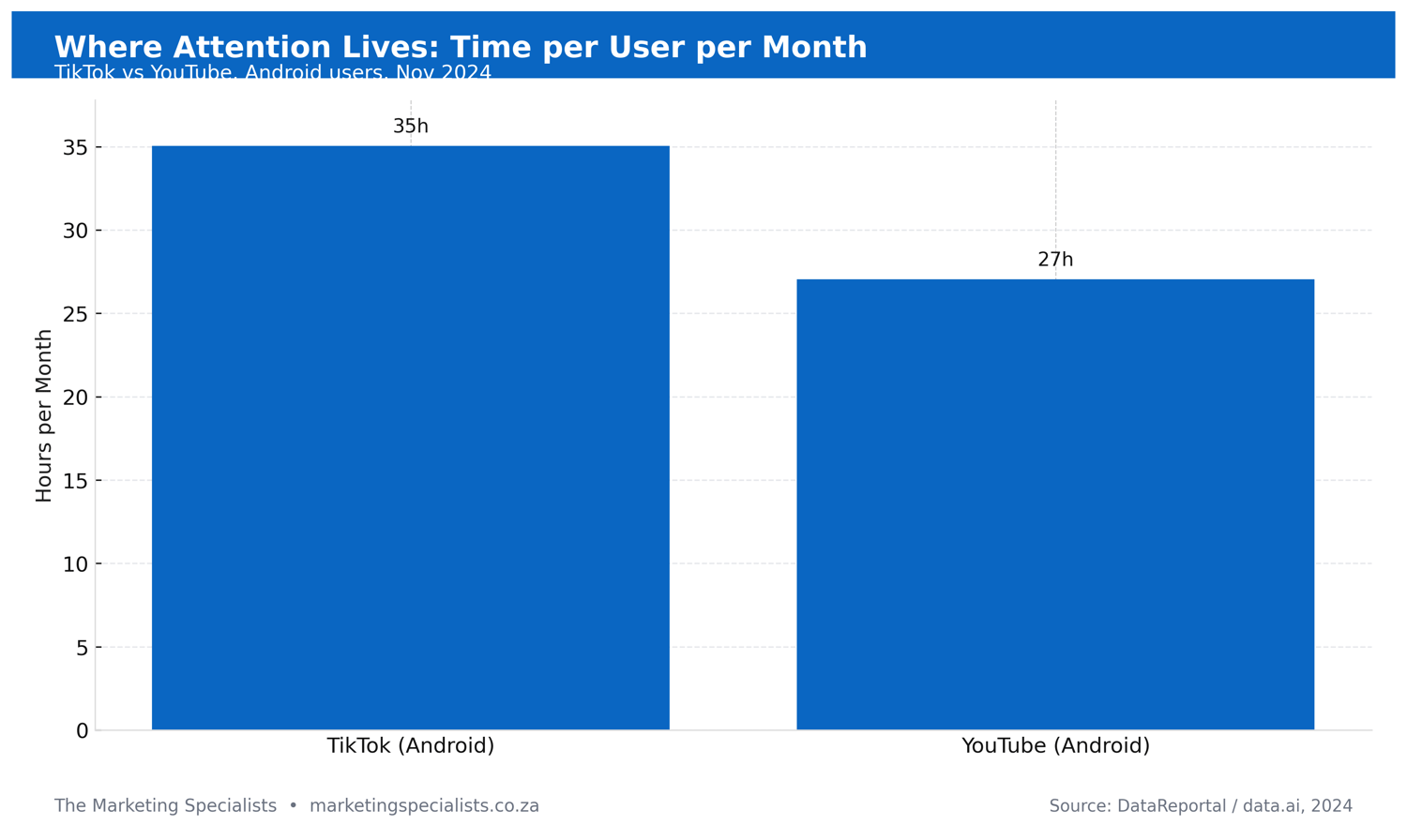
The sheer scale and engagement of TikTok cannot be ignored. By late 2025, TikTok's global ad reach had grown to 1.6 billion monthly users. In regions where it's available, TikTok's audience size is now comparable to or even larger than Instagram's. And as the graphic above shows, TikTok users are incredibly active, averaging over an hour a day on the platform, no other social network commands that much time. This means TikTok offers access to eyeballs and demographics (particularly Gen Z and young adults) that you might struggle to reach as effectively on Facebook or Google. Brands that master TikTok marketing (through clever short-form videos or partnering with creators) could tap into a vast well of consumer attention that competitors might be missing.
The same goes for other "new” channels: podcast audiences have grown significantly, and while advertising there might not have the same click-to-buy immediacy, it can be a powerful medium for branding and reaching niche, engaged communities. Connected TV ads (streaming TV commercials via Hulu, Roku, etc.) marry the storytelling of traditional TV with digital targeting; as cord-cutting continues, more consumers are reachable only via streaming platforms. Early adopters of CTV ads in certain industries could gain an edge as that medium matures.
The key is balance. The data suggests a smart strategy: maintain strong investment in your core channels that consistently deliver ROI, but devote a slice of your budget to experimentation. In practice, this could mean continuing to optimize your Google and Facebook campaigns (perhaps even increasing spend there if they're profitable), while also running small pilot campaigns on one or two new platforms. Maybe allocate 5-10% of your ad budget to test TikTok ads or sponsor a podcast for a few episodes, and closely track results. This way, you're not risking the farm, but you're gathering valuable data on what new opportunities might work for you. If the test yields good results, you can ramp up; if not, you've learned with minimal downside.
From the perspective of thought leadership content, you can leverage this insight by talking about how to evaluate new marketing channels wisely. You have the data-backed authority to say: "Yes, many business's are currently cautious, it's important to secure ROI on major platforms. But you don't want to miss out on where the audience is going.” You might share a case where a brand'successfully tried a new channel (for example, an Instagram-native brand branching into TikTok and seeing growth, or a B2B company finding success on an unexpected platform like Reddit or Quora). Emphasize a mindset of test, learn, and optimize.
As one VP of marketing noted, focusing only on the tried-and-true can "limit opportunities for growth and engagement with new audiences.” Brands should consider controlled experiments on emerging platforms to diversify their strategy without overspending. In sum, being too conservative can be as risky as being too cavalier, the leading marketers of 2026 will be those who excel at both exploiting proven channels and exploring new ones.
Launch Your Website in Minutes - Start For Free.
Conclusion: Data-Backed Strategy = Market Leader
Digital marketing in 2025 is defined by dynamic change, from the dominance of digital ad spend and shifts in ROI, to strategic refocusing on retention, rapid advances in AI, content marketing renaissance, and the ongoing evaluation of old vs. new channels. What ties all these threads together is the need for data-driven decision making. By grounding your marketing approach in facts and research (like the stats and studies cited above), you not only improve your results but also bolster your credibility as an expert.
To position yourself or your agency as a thought leader, keep sharing insightful data like these and explaining what it means. For instance, inform clients how you plan to harness the 3600% ROI power of email or navigate the 60% zero-click search reality in SEO. Discuss how you'll build loyalty programs that capitalize on the retention trend, or how your team stays at the cutting edge of AI without falling for the hype. Use concrete numbers; they impress readers and build trust that you've done your homework (because you have!).
In practice, this could lead to content pieces such as a blog post analyzing "Which Digital Channels Deliver the Best ROI in 2026?” with visual charts (much like we did here), or an eBook on "How AI is Changing Marketing - What the Data Says.” Such content not only educates your audience but also demonstrates your expertise and analytical approach, making business's more likely to reach out for your specialized help.
Remember, thought leadership is earned by providing value. With the original research and data-driven insights outlined above, you can spark conversations with compelling points ("Did you know TikTok users spend double the time Instagram users do?”) and guide your readers to actionable conclusions ("Maybe it's time to allocate a test budget to TikTok ads.”). By consistently delivering well-researched, interesting findings in the digital marketing space, you'll keep your audience engaged and position yourself firmly as an authority, one that clients can'trust to lead them through the ever-changing digital landscape.






















Comments (0)