


If generative AI is the intern who writ's fast, agentic AI is the operator who finishes the job. Agentic AI refers to systems (often called AI agents) that can'take a goal you give them, break it into steps, use tools (APIs, apps, databases, browsers), make decisions along the way, and complete multi-step work with limited supervision. Put simply: it does not just answer, it acts.
This guide explains what agentic AI is, how it works, what it can do in the real world, and how to implement it'safely and profitably, with practical examples you can use immediately.
What Is Agentic AI?
Agentic AI is an approach to building AI systems that behave like goal-driven agents. You provide an objective (for example, "audit my site for AI search readiness and propose fixes”), and the agent plans a sequence of actions, calls tools, checks results, and iterates until it completes the goal, hits a guardrail, or hands off to a human.
A helpful mental model:
- Generative AI: produces content (text, images, code) when prompted.
- Agentic AI: uses that'same intelligence plus planning, tool use, and feedback loops to get an outcome in the world.
If you want a plain-language definition from a public-sector perspective, the UK Government's AI Insights series is a good reference point for how policymakers are framing "agentic AI” and why it matters.
Why Agentic AI Is Exploding Right Now
Two forces collided:
- AI capability jumped fast, especially in reasoning and tool use.
- Organisations realised that "chat” alone does not move KPIs unless it connects to systems and completes workflows.
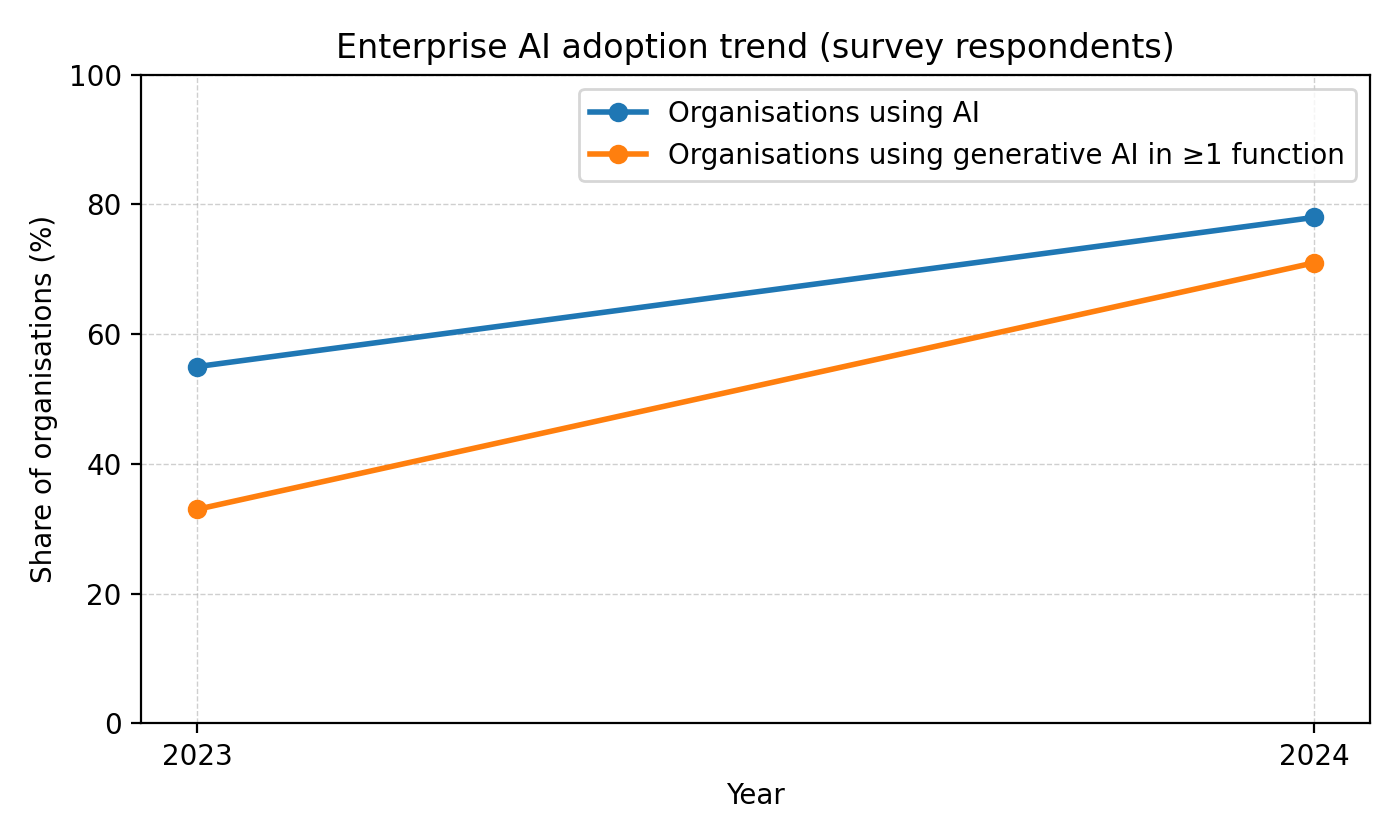
That'shift is visible in adoption data. Stanford's 2025 AI Index reports that 78% of organisations reported using AI in 2024, up from 55% the year before.
Agentic AI Vs Generative AI Vs Automation (What's Actually Different?)
Agentic AI vs generative AI
Generative AI is excellent at producing drafts, summaries, and ideas. Agentic AI is what you use when the work requires decisions and actions across systems, such as "collect data from five sources, compare options, create a plan, book meetings, and send the final pack for approval.”
Agentic AI vs RPA
Robotic Process Automation (RPA) is deterministic. It follows rigid rules and breaks when the process changes. Agentic AI can adapt, reason through ambiguity, and choose among tools, but must be constrained and monitored because it can also fail in unpredictable ways.
Agentic AI vs "AI assistants”
Assistants help you do tasks. Agents do tasks for you, within boundaries you set (permissions, budgets, approvals, and policies).
How Agentic AI Works
Most production-grade agentic systems follow a loop like this:
1) Goal intake and constraints
The user provides an objective plus constraints (deadline, budget, tone, compliance rules, allowed tools). This is where "agent instructions” and policies live.
2) Planning
The agent decomposes the goal into steps, chooses a strategy, and decides what information it'still needs. IBM describes this as breaking complex problems into smaller tasks and using tools to execute them.
3) Tool use (the difference-maker)
Tools are what turns an LLM into an agent. Tools can include:
- Web search and retrieval
- CRM actions (create lead, update deal)
- Analytics queries
- Writing to Google Docs
- Running code
- Calling internal APIs
Modern "agent builders” provide structured ways for models to call tools and return machine-readable outputs. OpenAI's agent tooling is a useful reference for how tool calling is implemented in practice.
Recommended external links to embed:
4) Memory and state
Agents often need:
- Short-term memory: what happened in this session
- Long-term memory: preferences, brand voice, product catalogues, policies
This is powerful, and risky, if you store the wrong data or allow the agent to "remember” things it'should not.
5) Reflection and verification
Good agents do not just act. They check:
- Did the action succeed?
- Does the output meet requirements?
- Is a human approval required?
This step is what reduces expensive failures.
6) Multi-agent orchestration
In more advanced setups, multiple agents collaborate: one researches, one drafts, one verifies, one executes actions. This can boost throughput, but it also increases coordination risk and makes governance more important.
What Agentic AI Can Do (High-Value Real-World Use Cases)
Agentic AI in marketing
Agentic AI shines when marketing becomes a workflow, not a document.
Examples that genuinely move metrics:
- Content operations agent: turns a keyword into a full publishing pipeline (SERP analysis, outline, draft, internal linking suggestions, schema markup, publishing checklist, performance tracking).
- Paid media agent: monitors spend and performance, drafts hypotheses, proposes budget shifts, prepares experiments, and queues changes for approval.
- SEO technical agent: audits templates, identifies indexation issues, generates priorit'sed fixes, and creates tickets for dev.
If your goal is visibility in AI-powered search, consider linking your internal resource here:
- AI Search & GEO Audit
- This fits naturally because agentic systems increasingly surface brands that are technically accessible, consistently cited, and semantically clear.
Agentic AI in sales and RevOps
- Lead qualification agent: enriches leads, scores them, drafts personalised outreach, schedules follow-ups, and updates CRM fields.
- Proposal agent: assembles case studies, pricing, scope, and compliance clauses, then routes to a human for final approval.
Agentic AI in customer'support
Banks and other regulated industries are actively piloting customer-facing agentic systems, with regulators highlighting both the promise and the new risks introduced by autonomy and speed.
Agentic AI in IT and engineering
- Incident response agent: correlates logs, proposes probable causes, drafts runbooks, and suggests mitigations.
- Code maintenance agent: triages issues, proposes patches, and runs tests.
If you mention engineering agents, keep it honest: benchmark performance is improving quickly, but reliability still varies by task and constraints. The AI Index notes that performance on demanding benchmarks like SWE-bench has moved significantly in short periods.
How To Implement Agentic AI
This is the section that usually separates a "rankable” article from a vague one.
Step 1: Pick workflows that deserve autonomy
Start with workflows that have:
- Clear success criteria (done or not done)
- Low-to-medium risk
- High repetition
- Strong data access and tool access
A simple rule: if you cannot describe "done” in one sentence, it is not ready for an agent.
Step 2: Convert your workflow into a checklist first
Before you build an agent, map the workflow as if a human assistant must follow it. This exposes missing steps, hidden approvals, and data gaps.
Internal links that fit naturally here:
- Content Audit Checklist
- Technical SEO Audit Checklist
Step 3: Decide the autonomy level (and be strict)
Use a simple maturity model:
- Level 0: Suggests actions only
- Level 1: Executes actions in a sandbox
- Level 2: Executes actions with human approval
- Level 3: Executes actions with policy guardrails and audit logs
- Level 4: Executes actions across multiple systems with limited approvals (rare, high governance)
Most business's should live at Level 2 to Level 3 for a long time.
Step 4: Build the tool layer before the "agent brain”
Your tool layer is the real product:
- Clean APIs
- Permissioning
- Rate limits
- Logging
- Rollback
This is also where you'reduce hallucinations: the agent should fetch facts from systems, not invent them.
Step 5: Add guardrails that match real-world risk
At minimum:
- "Allow list” tools the agent can use
- Spend limits and time limits
- Approval gates for irreversible actions
- A clear escalation path to a human
If you want an authoritative framework to reference, NIST's AI Risk Management Framework is designed to help organisations map, measure, and manage AI risks across the lifecycle.
Step 6: Evaluate agents like you would evaluate staff
Do not only test "does it work once”. Test:
- Accuracy under messy inputs
- Failure handling
- Consistency over time
- Security and data leakage behaviour
Step 7: Roll out with monitoring and auditability
Treat agent decisions like production changes:
- Version control for prompts and policies
- Logs for tool calls and outputs
- Post-incident reviews when things go wrong
The Compliance And Governance Section You Should Not Skip
Agentic AI increases impact, which increases responsibility.
Key risks to explain clearly
- Incorrect actions taken at speed
- Data exposure via tool access
- Misaligned goals (the agent optimises the wrong thing)
- Over-automation of decisions that require human judgement
EU AI Act timeline
Even if your readers are not in the EU, the EU AI Act is shaping how many global companies approach governance. The Act entered into force on 1 August 2024, with phased application dates, including prohibitions and AI literacy obligations from 2 February 2025, GPAI obligations from 2 August 2025, and broader application from 2 August 2026, with some high-risk transitions extending to 2 August 2027.
OECD AI Principles
The OECD's AI principles and updates are widely referenced in policy discussions and governance programmes. They emphasise human-centred values, robustness, transparency, and accountability.
Generative AI usage among individuals (EU)
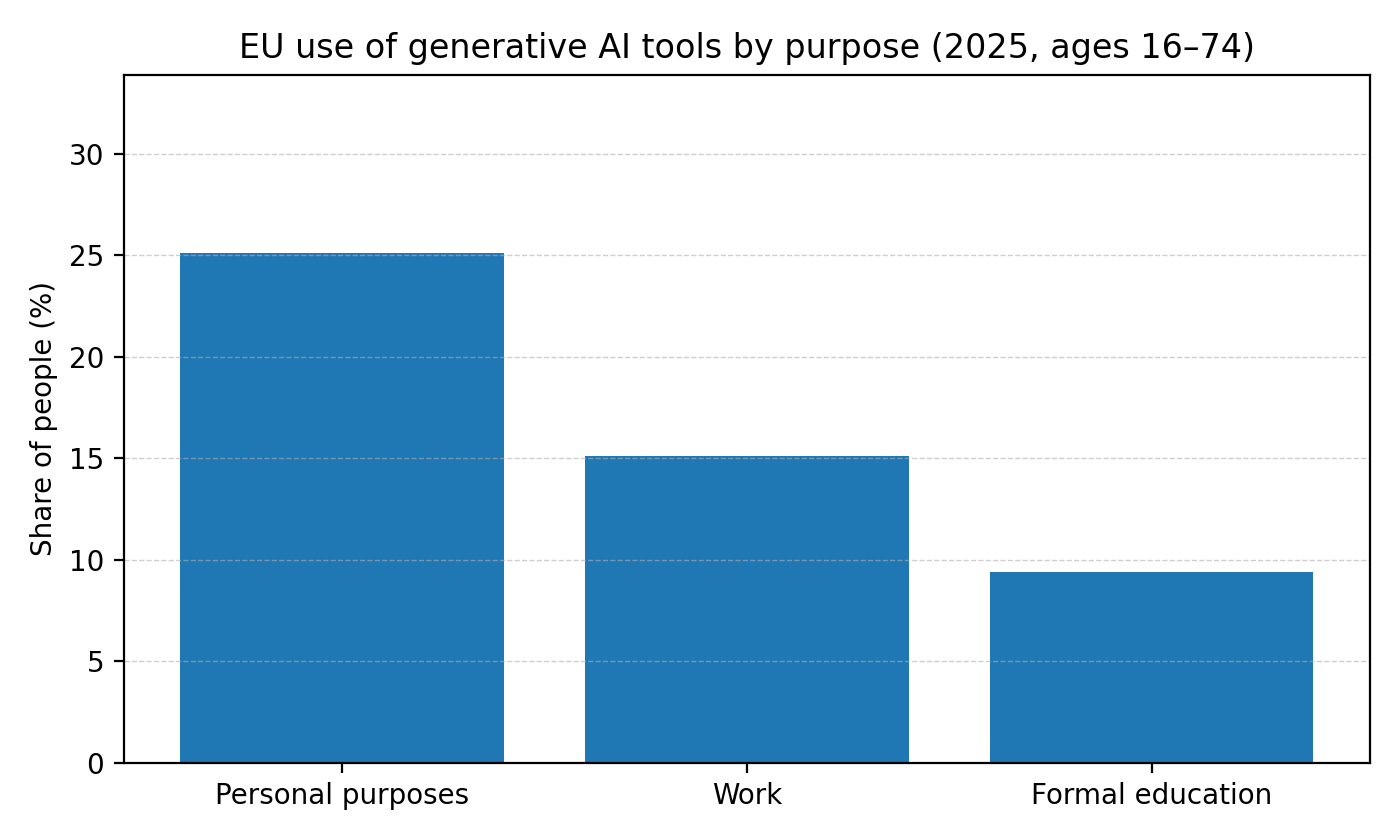
Eurostat reports that 32.7% of people aged 16-74 in the EU used generative AI tools in 2025, most commonly for personal purposes (25.1%), then work (15.1%), and formal education (9.4%).
AI usage among enterprises (EU)
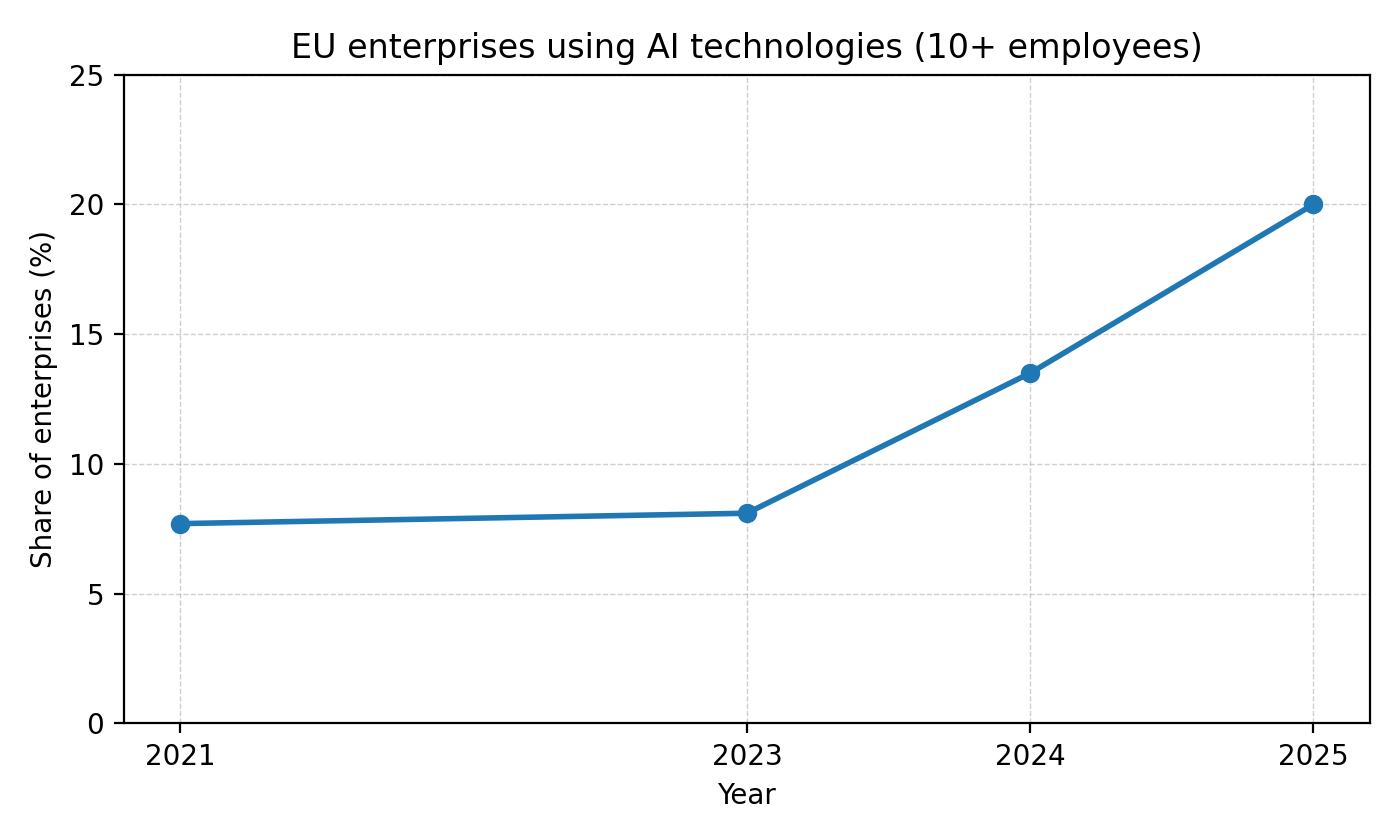
Eurostat reports that 20.0% of EU enterprises with 10+ employees used AI technologies in 2025, up from 13.5% in 2024, with earlier reference points in 2021 and 2023 also noted in the same release.
How To Utilise Agentic AI In A Marketing Business
Here is a realistic "agentic SEO sprint” workflow
- The agent ingests the target keyword, audience, and conversion goal.
- It analyses search intent and drafts a content structure.
- It pulls internal link targets from your site (services, audits, tools).
- It drafts the article, then runs a self-check for factual claims vs sources.
- It generates FAQ schema and proposes metadata.
- It produces a publishing checklist and measurement plan.
FAQ: Agentic AI
Is agentic AI the same as an AI agent?
In most modern usage, agentic AI describes the approach, and an AI agent is an implementation of that approach.
Do I need to code to use agentic AI?
Not always. Many teams start with workflow automation plus an LLM, then graduate to more advanced orchestration as needs grow. What matters most is tool access, permissions, and evaluation.
What is the biggest mistake people make with agentic AI?
Giving it too much autonomy too early, without guardrails, logs, and approvals.
Will agentic AI replace jobs?
It will replace tasks first. The teams that win are the ones who redesign workflows so humans do judgement, strategy, and creative direction, while agents handle execution and analysis.
Can agentic AI be trusted?
It can be trusted for specific workflows when it is constrained, monitored, and evaluated continuously. NIST's AI RMF is a practical reference for building that trust.




















Comments (0)